Williamsburg County Dog Registration Information
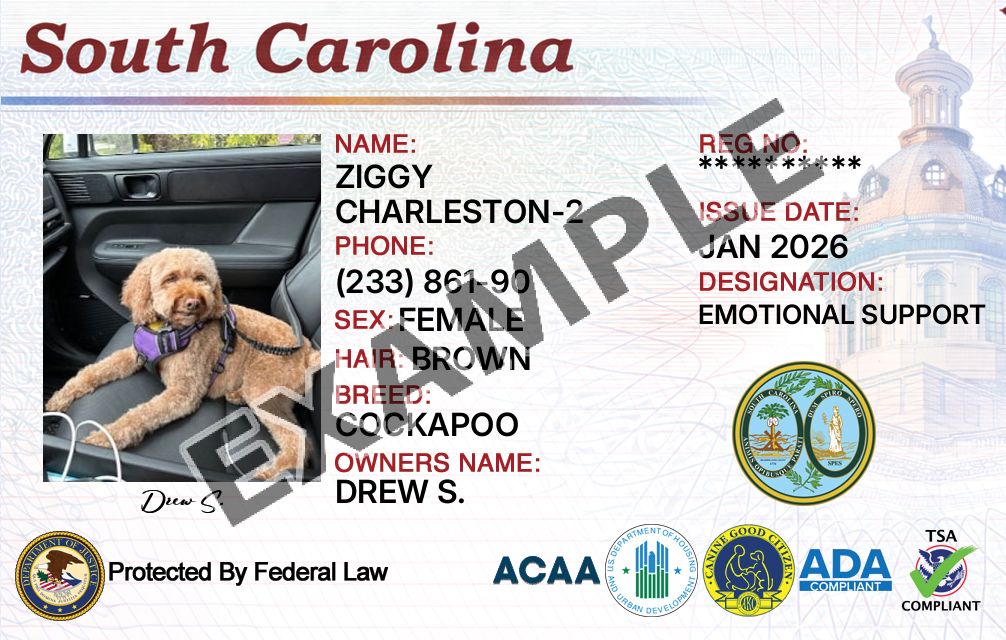
Service Dogs and Emotional Support Animals in Williamsburg, South Carolina
If you’re searching where do i register my dog in Williamsburg County, South Carolina for my service dog or emotional support dog, the most important thing to know is this: dog licensing and rabies compliance are usually handled locally (county or city), while service dog and emotional support animal (ESA) status are legal/medical concepts that are not created by buying a license online or “registering” through a private company.
This page explains how a dog license in Williamsburg County, South Carolina typically works, what rabies documentation you may need, and where to start with the county offices that handle animal-related enforcement and public safety. It also clarifies the real differences between a local dog license, a service dog under federal law, and an ESA used for housing accommodations.
Where to Register or License Your Dog in Williamsburg County, South Carolina
Because animal control, rabies enforcement, and licensing (where applicable) are most often managed at the local level, these are example official offices within Williamsburg County, South Carolina to contact first when you need to confirm where to register a dog in Williamsburg County, South Carolina, how to obtain tags, what fees apply, and what proof is required.
Official County Offices (Examples)
| Office | Address | Phone | Hours | |
|---|---|---|---|---|
|
Williamsburg County Animal Care & Control
County animal care, complaints, enforcement
|
200 County Camp Road
Kingstree, SC 29556
|
843-355-9312 | animalcare@wc.sc.gov | Not listed |
|
Williamsburg County (Main “Contact Us” / Administration)
General county contact and department routing
|
201 W Main Street
Kingstree, SC 29556
|
843-355-9321 | Not listed | Not listed |
|
Williamsburg County Non-Emergency (Animal/Litter Complaints)
Use for complaints; emergencies should go through 911
|
Not listed | 843-354-0606 | Not listed | Not listed |
Overview of Dog Licensing in Williamsburg County, South Carolina
What people mean by “registering a dog”
When residents ask where to register a dog in Williamsburg County, South Carolina, they may mean one (or more) of the following:
- Local dog license/tag (if required): A county or city-issued license/tag that helps show the dog is associated with an owner and may support local animal control and shelter operations.
- Rabies compliance documentation: Proof your dog is vaccinated for rabies (often required by state/local rules and commonly requested after a bite, during certain enforcement actions, or when using some services).
- Microchip registration: A voluntary identification method tied to a microchip number (usually done through the chip manufacturer’s database). This is different from a government license.
Who usually handles licensing and enforcement
In South Carolina, licensing practices can vary by locality. Most of the “day-to-day” questions—fees, renewal timing, what tags look like, and how rabies proof is accepted—are answered by the local agency that handles animal control and enforcement. For Williamsburg County residents, that generally means starting with county animal care and control, then confirming whether your specific town has additional ordinances.
Rabies vaccination requirements (why they matter for licensing)
Whether you have a pet dog, a working service dog, or an emotional support animal, rabies vaccination is one of the most common “must-have” requirements. Even when a locality does not issue a formal annual license tag, rabies proof is frequently the key document animal control will ask for. Keep your dog’s rabies certificate in a safe place and consider keeping a photo copy on your phone for quick access.
How Dog Licensing Works Locally in Williamsburg County, South Carolina
Step 1: Confirm the correct local office for your address
Williamsburg County includes unincorporated areas and municipalities. Because rules can be different depending on whether you live inside a town’s limits, the first step is to confirm which agency is responsible for your address for animal-related rules. If you’re not sure, contact the county’s main line and ask to be routed to animal care and control.
Step 2: Ask whether your area issues a formal dog license/tag
Some places issue an annual or lifetime license; others focus on rabies vaccination records and enforcement through animal control. When you call, ask:
- Is a dog license in Williamsburg County, South Carolina required for all resident dogs?
- Is there a separate town license if I live inside town limits?
- Do you issue tags, and what documents are needed to obtain them?
- Are there reduced fees or waivers for certain situations (for example, government-recognized service dogs), and what proof is required?
Step 3: Prepare your documents
Even if you are asking about an animal control dog license Williamsburg County, South Carolina for a service dog or ESA, the requested documentation often overlaps with standard pet licensing. The most common documentation categories are rabies vaccination proof, identification, proof of residency, and payment of a licensing fee (where applicable).
Step 4: Understand what “registration” will (and won’t) do
Local licensing can support reunification if your dog is found, helps verify rabies compliance, and may be required by ordinance. However, a local dog license:
- Does not automatically grant service dog access rights.
- Does not turn a pet into an emotional support animal.
- Does help show your dog is properly documented locally (especially for rabies compliance).
Service Dog Laws in Williamsburg County, South Carolina
What makes a dog a service dog (and what does not)
A service dog is generally understood as a dog that is individually trained to do work or perform tasks for a person with a disability. The key is trained tasks that relate to the disability (for example, guiding, alerting, retrieving, interrupting certain symptoms, or providing mobility support). Buying an ID card online or listing your dog in a private database does not create legal service-dog status.
How local licensing interacts with service dogs
Even when a dog is a legitimate service dog, it is still a dog living in the community. That means local rules—especially rabies vaccination requirements and any applicable local licensing/tag requirements—may still apply. If you are trying to figure out where do i register my dog in Williamsburg County, South Carolina for my service dog, the practical answer is: contact the same local offices that handle standard dog licensing and ask if any fee exemptions, documentation standards, or tag options exist for service dogs.
Public access basics (service dogs vs. pets)
Service dogs are generally allowed to accompany their handler in many public places where pets are not allowed. However, access can depend on behavior and control: service dogs must typically be under control (leashed, tethered, or otherwise controlled if a leash interferes with work) and housebroken. A service dog that is out of control or not housebroken may be required to leave, even if it is a real service animal.
Emotional Support Animal Rules in Williamsburg County, South Carolina
What an ESA is (and where it matters)
An emotional support animal (ESA) is generally a companion animal that provides emotional benefit to a person. ESAs are most commonly relevant in housing contexts (for example, requesting a reasonable accommodation). An ESA is not the same as a service dog because it is not defined by trained tasks.
ESAs vs. service dogs: key differences
- Dog license: A local administrative requirement (where applicable). It does not establish disability-related access rights.
- Service dog: A dog trained to perform specific tasks related to a disability; often has broader public-access protections.
- Emotional support animal: Provides comfort/support; typically addressed through housing accommodations rather than general public access.
Do you “register” an ESA with the county?
In most cases, there is no county ESA “license” that changes your animal’s legal classification. If you are asking where do i register my dog in Williamsburg County, South Carolina for my emotional support dog, focus on two separate tracks:
- Local compliance track: Follow any local rules that apply to all dogs (rabies vaccination proof and any required dog license/tag).
- Accommodation track (housing): If you need an ESA for housing, be prepared to follow your housing provider’s reasonable accommodation process. Keep documentation organized, respond promptly to requests for information, and make sure your animal can be safely and reasonably accommodated.
Why avoiding third-party “registries” helps
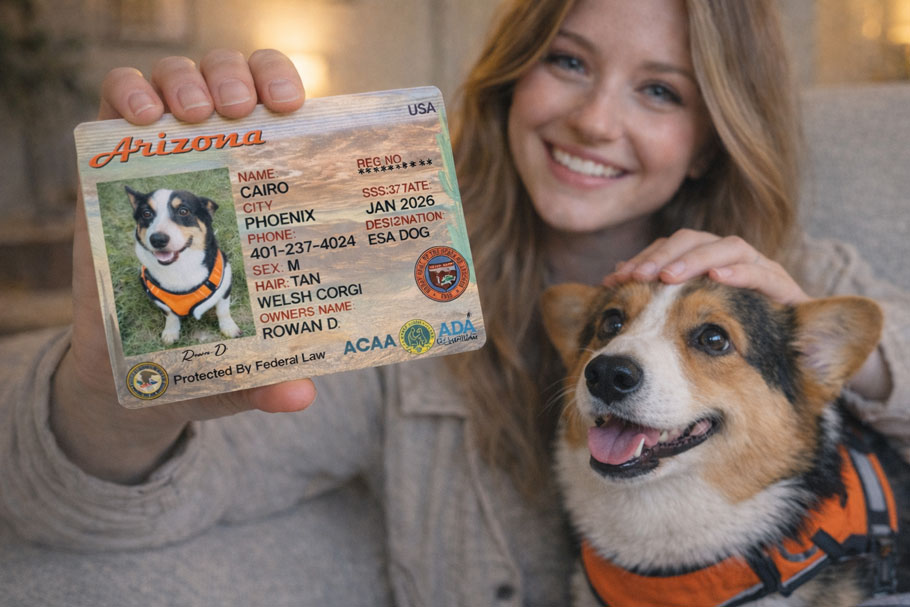
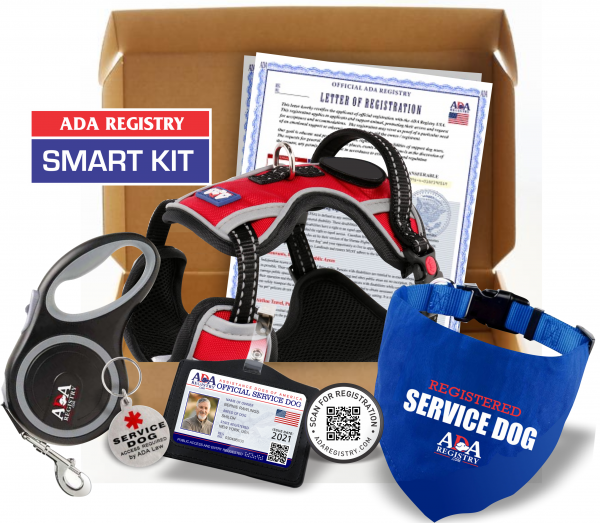
Many websites sell certificates, “registrations,” vests, and ID cards. These are not required to comply with local dog licensing, and they do not automatically create service dog or ESA rights. If your goal is to do things correctly in Williamsburg County, your best first call is the local animal care and control office to confirm what the county actually requires for rabies and licensing.
Frequently Asked Questions
Register A Dog In Other South Carolina Counties
Select your county below to get started with your dog’s ID card. Requirements and license designs may vary by county, so choose your location to see the correct options and complete your pup’s registration.
- Abbeville County Dog Registration
- Aiken County Dog Registration
- Allendale County Dog Registration
- Anderson County Dog Registration
- Bamberg County Dog Registration
- Barnwell County Dog Registration
- Beaufort County Dog Registration
- Berkeley County Dog Registration
- Calhoun County Dog Registration
- Charleston County Dog Registration
- Cherokee County Dog Registration
- Chester County Dog Registration
- Chesterfield County Dog Registration
- Clarendon County Dog Registration
- Colleton County Dog Registration
- Darlington County Dog Registration
- Dillon County Dog Registration
- Dorchester County Dog Registration
- Edgefield County Dog Registration
- Fairfield County Dog Registration
- Florence County Dog Registration
- Georgetown County Dog Registration
- Greenville County Dog Registration
- Greenwood County Dog Registration
- Hampton County Dog Registration
- Horry County Dog Registration
- Jasper County Dog Registration
- Kershaw County Dog Registration
- Lancaster County Dog Registration
- Laurens County Dog Registration
- Lee County Dog Registration
- Lexington County Dog Registration
- Marion County Dog Registration
- Marlboro County Dog Registration
- McCormick County Dog Registration
- Newberry County Dog Registration
- Oconee County Dog Registration
- Orangeburg County Dog Registration
- Pickens County Dog Registration
- Richland County Dog Registration
- Saluda County Dog Registration
- Spartanburg County Dog Registration
- Sumter County Dog Registration
- Union County Dog Registration
- York County Dog Registration